Home / Journal / Egyptian painting: a short history
Egyptian painting: a short history
The paintings on the walls of Egyptian tombs were not made to be looked at. They were made to work: to supply the dead with fields, cattle, bread and beer for eternity, and to fix the owner’s name and face so that the person would go on existing. That purpose explains almost everything about how they look.
Why the figures are drawn that way
Egyptian painters drew what they knew to be there, not what they saw from one spot. A head in profile, with the eye seen from the front; shoulders square to the viewer; legs and feet in profile again. It is not clumsiness — the same artists drew animals, birds and fish with sharp naturalism — but a convention: the figure had to be complete, every part present and legible, because an incomplete body could not be inhabited. Size shows rank, not distance: the tomb owner is tallest, his wife a little smaller, servants and children smaller still.
The painters worked on a grid. A wall was squared up with red string snapped against the plaster, and figures were drawn to fixed proportions — eighteen squares from the sole of the foot to the hairline in the Middle and New Kingdom canon. That is why figures from different tombs, centuries apart, stand the same way.
Pigments and surfaces
The palette was mineral and stable, which is why the colors survive: carbon black, gypsum and calcite white, red and yellow ochres, Egyptian blue (a manufactured copper-calcium silicate, the first synthetic pigment) and malachite green. Paint was applied in flat areas with a gum binder onto a thin lime plaster over mud plaster, and outlined last in red or black.
Where the prints come from
Few people see the tombs themselves — the Theban necropolis near Luxor, where the tomb of Menna, Nakht, Sennedjem and Nefertari lie, is a long way from most living rooms, and the chambers are small and dark. Between 1907 and 1937 the Metropolitan Museum’s Egyptian Expedition employed a team of painters to make exact, full-scale facsimiles of the wall paintings in watercolor and gouache: Norman and Nina de Garis Davies, Charles Wilkinson, Hugh Hopgood and others. They worked by lamplight, tracing and then copying color by color, and recorded damage that has since grown worse. The results are the clearest record of Egyptian painting that exists, and they hang in the Met’s Egyptian galleries.
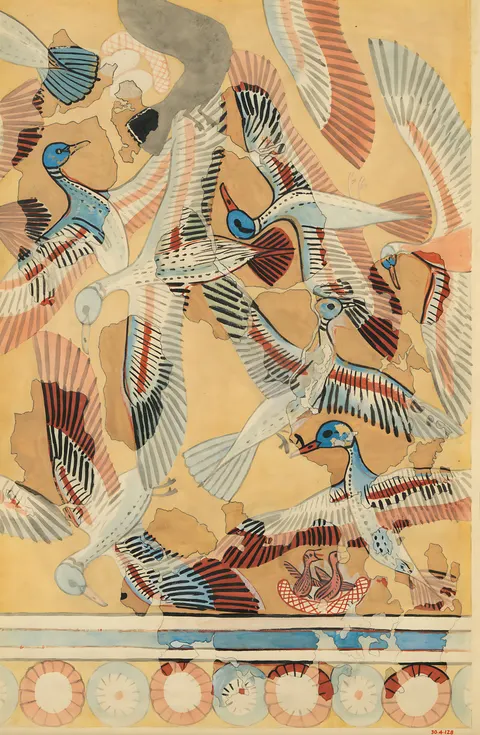
Our Egyptian collection is printed from those facsimiles, which the Met has released as public-domain images, and from the plates of the archaeologist and painter W. J. Palmer-Jones, whose copies of the marsh scenes — the flying ducks, the bull among the papyrus — were made for archaeological publications in the 1920s. The product pages name the painter, the tomb and the source.
Reading a scene
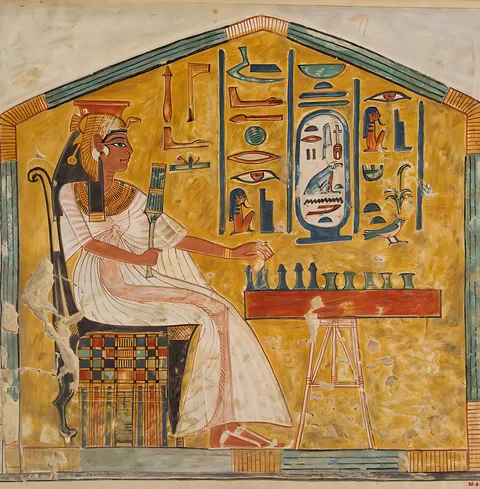
Menna hunting in the marshes (tomb TT69, about 1400 BC) is the classic: the official stands on a papyrus skiff, throwing stick raised, a cat and a mongoose raiding the nests, fish in the water drawn as if seen through glass. Sennedjem in the Fields of Iaru (TT1, about 1200 BC) shows the afterlife itself as farmland: the artisan and his wife plowing and reaping in white linen in a field bordered by water. Nefertari playing senet (QV66, about 1250 BC) is a queen at a board game, alone, the game a metaphor for the passage through the underworld.
On a wall these read as pattern first — flat fields of ocher, blue and green, bands of hieroglyphs as a border — and as stories second, which is what makes them unusually good as large prints: they hold a room from across it and reward standing close.
Sources
- The Metropolitan Museum of Art — Facsimiles of Egyptian wall paintings (Graphic Section of the Egyptian Expedition)
- The Metropolitan Museum of Art — Menna and Family Hunting in the Marshes, Nina de Garis Davies
- Theban Mapping Project — tombs of the nobles and the Valley of the Kings
Every piece is a new print made to order: studio artwork created for this shop, or a restored public-domain work. New made-to-order prints — not originals or antiques, not hand-painted; restored works (paintings, prints and historic photographs) are new prints made from museum scans. Colors vary by screen and by material.