Printed & framed in the USA Made to order, most in 3–5 business days Sizes up to 60 in Free replacement if damaged Free US shipping, no minimum

Egyptian Wall Art

Sennedjem in the Fields of Iaru

Facsimile by Charles K. Wilkinson, 1922, of a painting from the Tomb of Sennedjem (TT 1), Deir el-Medina, Thebes, ca. 1300–1224 BCE, Dynasty 19

The Metropolitan Museum of Art, Rogers Fund, 1930 · 1922; original ca. 1300–1224 BCE

$439

For 36×24 in, float frame canvas, black

Printed & framed in the USA

Made to orderShips in a flat box or tubeDamaged or not what you ordered? Tell us within 7 days of delivery — free replacement

Step 1 of 3

Choose a size

Size

Will it fit? Check these sizes against your wall

Measure the wall between whatever bounds it — window trim, a doorway, the corner. Sizes are judged hung (frame included) with 6 in of breathing room, two-thirds the width of the furniture under them, and the center at eye level (57–60 in). Guidance, not a guarantee: the true-size template is the final check.

Step 2 of 3

Choose a finish

For 36×24 in ·

Finish · prices for 36×24 in

Having rolled canvas framed locally? Give your framer the canvas size.

Step 3 of 3

Review your art

Art
Sennedjem in the Fields of Iaru
Size
36×24 in ·
Finish
Float frame canvas, Black ·
Price
$439
  • Made to order just for you: printed, finished and packed within 3–5 business days. Your order reaches the printer within minutes and printing can start soon after; once it starts, the order can't be canceled or changed.
  • Free replacement if it arrives damaged, defective or not what you ordered — tell us within 7 days of delivery, with photos. Because each piece is made for you, there are no returns for a change of mind. Full policy
  • No hanging hardware is included. Stretched and framed canvases hang flat on two nails or screws, set level: the wooden bar on the back rests on them, and the free wall template marks the spot. Rolled canvas goes to a framer first.
  • Printed from an archive scan of the original print (1922; original ca. 1300–1224 BCE). Its paper tone, small spots and marks of age are part of the picture, just as on the original sheet, and colors can look slightly different on your screen.

Powered by StripeApple Pay · Google Pay · Link · Cards at checkout

36×24 in · Float frame canvas, Black$439

Shipping & delivery
  • Free US shipping, no minimum

How it gets to you · item no. 429 · SKU EGY-LAS0429-FFL-24X36

  1. Printed for youwithin 3–5 business days
  2. Shipped with tracking3–8 business days after printing
  3. Delivered to your doorFree US shipping, no minimum · tracking link emailed

Before you hang it, print the true-size wall template to see exactly where it will sit.

Returns & cancellations

Please check before you buy. Your order goes to the printer within minutes, and once printing starts, made-to-order pieces can't be canceled, changed or returned for a change of mind, so please check the size guide and room views first. If it arrives damaged, defective or not what you ordered, we'll replace it free within 7 days. Full policy

Materials & finish

Printed on 400 gsm canvas with pigment inks. Stretched canvas and float frame canvas sit on a 1.5 in (38 mm) wooden stretcher; the classic frame holds the canvas on a slimmer 0.75 in (19 mm) stretcher. Rolled canvas ships in a sturdy tube.

The float frame stands 2.1 in (53 mm) off the wall, with a 0.5 in (12 mm) face and a 0.2 in (5 mm) gap around the canvas. The classic frame stands 0.9 in (22 mm) off the wall with a 0.8 in (20 mm) face.

Hanging hardware is not included. Two picture hooks (or screws) rated for the weight, set level, are all it needs; the free true-size wall template marks the spot.

Corner of a Black float frame canvas: the canvas sits inside the frame with a narrow gap Back of a float frame canvas: wooden stretcher inside the frame, no hanging hardware fitted Cross-section of the float frame: 53 mm deep, 12 mm face, 5 mm gap, 38 mm canvas
The float frame up close: front corner, the back as it arrives, and its cross-section. Photos: Prodigi, who print and frame our pieces.

Every finish is printed from the same file at the same resolution; only the mounting changes.

Share or save Save Facebook X Email
Rights & provenance record

Source scan: The Metropolitan Museum of Art (Open Access)
Rights statement of the archive: “Public domain. The Metropolitan Museum of Art releases this image under Creative Commons Zero (CC0) as part of its Open Access program.”
Facsimile: Charles K. Wilkinson, 1922, painted for The Metropolitan Museum of Art's Egyptian Expedition; original painting: ca. 1300–1224 BCE, Facsimile H. 54 cm (21 1/4 in); W. 84.5 cm (33 1/4 in); Framed H. 58.1 cm (22 7/8 in); W. 88.6 cm (34 7/8 in). Verified 2026-10-12.

This product is a new print made to order from a restored scan of that print. It is not an original antique and is not sold as one.
The story of this print

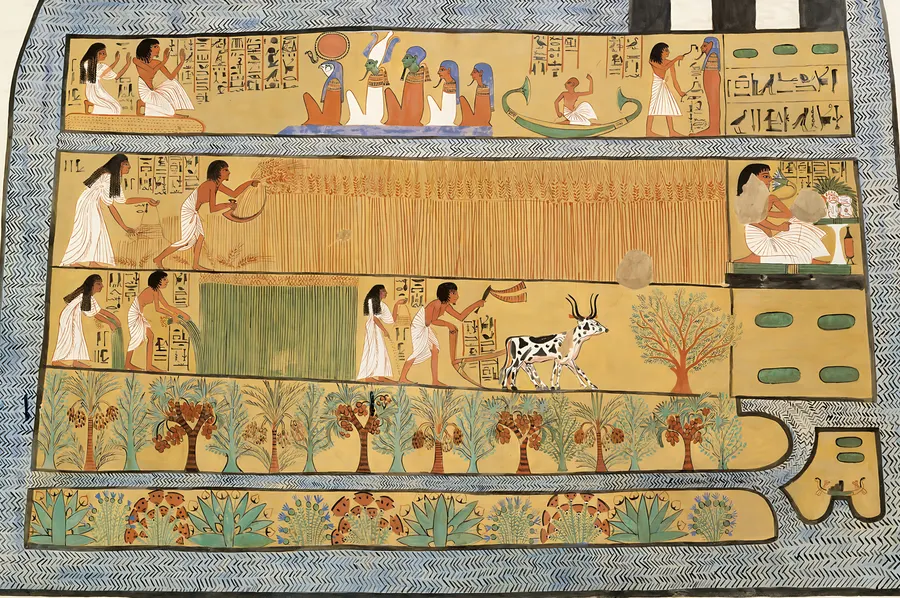
The Fields of Iaru were the Egyptian paradise: a land like Egypt itself, only better, where the grain grew taller and the work was a pleasure. On the wall of his tomb at Deir el-Medina, the craftsman Sennedjem painted himself and his wife Iineferti there. In neat bands framed by a border of blue water, they kneel before the gods, reap golden wheat, plow behind spotted cattle and gather flax, and along the bottom runs a garden of date palms, sycamores and flowers.

This print is made from the full-size facsimile that Charles K. Wilkinson painted in tempera in 1922 for the Metropolitan Museum’s Egyptian Expedition, copying the wall on site. The Met releases its photograph into the public domain, and we print it as published, enlarged 2× for print. The rich yellows, greens and blues make it one of the warmest Egyptian pictures for a living room or study.

What we did to this scan

  1. Used as the museum photographed and published it: no retouching and no color changes.
  2. Trimmed off the dark mount around the facsimile in the museum's photograph.
  3. Enlarged 2× for print with Real-ESRGAN, an AI upscaler, so the brushwork holds at large sizes.

About this particular sheet. Made from The Metropolitan Museum of Art's Open Access photograph of the facsimile, with the dark mount edge round it trimmed off and the photograph enlarged 2× for print; the museum's record is linked on this page. Cracks, losses and faded areas are part of the facsimile, which records the wall as it was found.

Every print is credited to its archive here and in your order confirmation. Paper tone and small imperfections of the original are kept on purpose; nothing is redrawn. How we restore.

Questions

What does it show?
The craftsman Sennedjem and his wife Iineferti working the fields of the afterlife, in bands framed by a blue border of water: at the top they kneel before seated gods, then they reap tall golden grain, plow with a pair of spotted cattle and harvest flax, and at the bottom a garden of palms and flowers lines the water.
Is it the original?
It is a print of a full-size facsimile that Charles K. Wilkinson painted in tempera in 1922 by copying the original wall painting on site, for the Metropolitan Museum of Art's Egyptian Expedition. The Met releases its photograph of the facsimile into the public domain (CC0); we print that photograph, enlarged 2× for print, with nothing retouched.
Where does it hang best?
A living room, a study, a dining room or a hallway; anywhere a piece of history earns its space. The earthy reds, yellows and blues sit well with wood, brass, linen and terracotta.
How is it made?
It is printed to order for you, in the finish you choose: a float frame canvas, a classic frame canvas, a stretched canvas, a rolled canvas or an acrylic panel. Both frames come in Black or Antique Gold. The size and finish picker shows which sizes each finish is made in.
Colors vary a little between screens and canvas. The previews are drawn, not photographed, and are a close match to the printed piece.

Every size, one wall

All 6 sizes of this print, side by side

To scale, framed, with a 5 ft 6 in figure for reference — so you can see the steps between sizes at a glance before you pick one above.

Left to right: 60×40 in · 48×32 in · 36×24 in · 30×20 in · 24×16 in · 18×12 in

Every size to scale on one wall, framed in Black, beside a 5 ft 6 in figure. Room photograph generated for scale; the figure is 5 ft 6 in.

More from Egyptian Wall Art

Sennedjem in the Fields of Iaru — drag to pan, scroll or pinch to zoom
Size guide
5′6″ 16×12 in24×18 in36×24 in
SizeMetricBest for
18×12 in46×30 cmDesk, shelf, small wall, gallery groupings
24×16 in61×41 cmAbove a desk or console, hallway, bedroom
30×20 in76×51 cmOver a sofa or bed, statement wall, office
36×24 in91×61 cmOver a sofa or bed, statement wall, office
48×32 in122×81 cmOver a sofa or bed, statement wall, office
60×40 in152×102 cmOver a sofa or bed, statement wall, office

Sizes are the canvas size. A framed piece is a little larger than its canvas: add the frame.