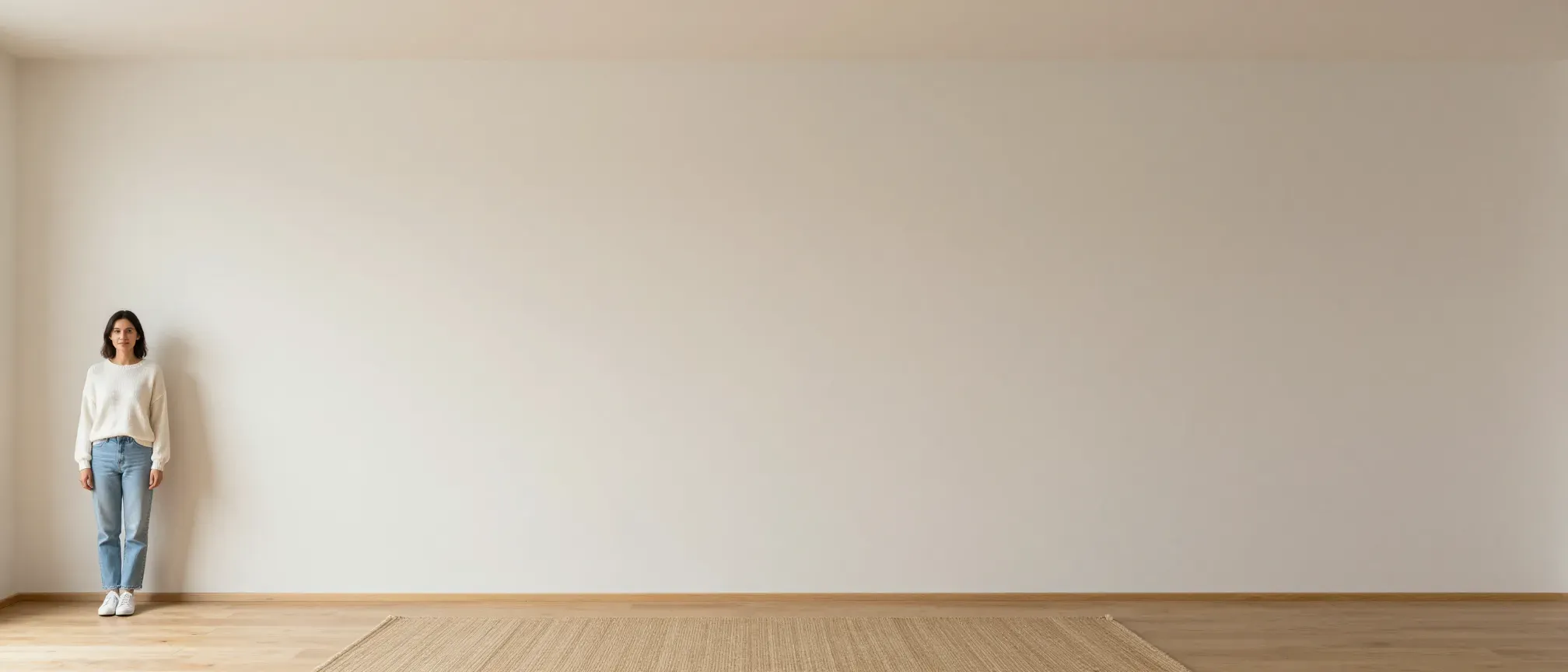
Every size drawn to scale on one wall, above the sofa in a photographed room. Sizes are the canvas; a frame adds a little on every side. Not drawn, so the labels stay readable: 20″ × 20″ — it sits between the sizes shown, and it is in the size picker.
Print proof — This is the exact file our printer receives for this size, so what you see here is what gets printed, edge to edge. Use it to see how much margin a size leaves and, before you buy a large size, to check the sharpness in the 100% close-up.
edge of the print
The file
Actual pixels at this size
Colors on a screen can look slightly different from ink on canvas. This file goes to the printer automatically when you order, and your piece ships straight from the print studio to you.
Living room 1 / 9
Wall color
Rooms to scale: each was measured against a 5 ft 6 in figure, so the print is drawn at its true size against the furniture. Rooms and people are generated images. Swipe the room, tap a dot, or press Next room to see the print in another room. Drag the print to try another spot (or move it with the arrow keys); switch sizes above to compare.
Step 1 — set the scale. Drag the slider until the gold bar on the photo is the height of a standard doorway (80 in / 203 cm). Every size you pick is then drawn true to life.
Step 2 — drag the print to where it would hang, and change size or frame above to compare.
Source scan:The Metropolitan Museum of Art (Open Access, CC0) Rights statement of the archive: “Public domain: Roman wall painting, last decade of the 1st century BCE (ancient). The Metropolitan Museum of Art marks this object Public Domain and releases its photograph under Creative Commons Zero (CC0) as part of its Open Access program (Met 250930 / 20.192.1).” Original print: Roman, last decade of the 1st century BCE, Overall: 91 3/4 x 45in. (233.1 x 114.3cm). Verified 2026-10-20.
This product is a new print made to order from a restored scan of that print. It is not an original antique and is not sold as one.
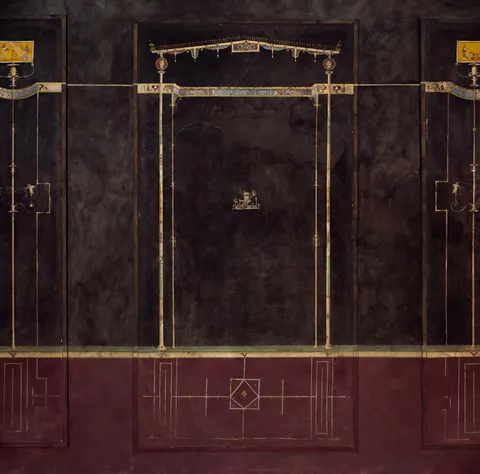
The Black Room: Aedicula with a Small Landscape
The story of this print
From the Black Room of the imperial villa at Boscotrecase, built for the family of the emperor Augustus: a wall of polished black with almost nothing on it but hair-thin golden columns, a delicate pediment and a few small ornaments. In the middle of the frame floats a tiny landscape, and a band of dark red with fine gold lines runs along the bottom.
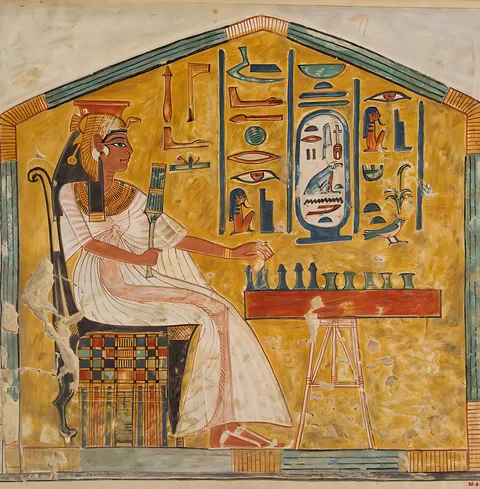
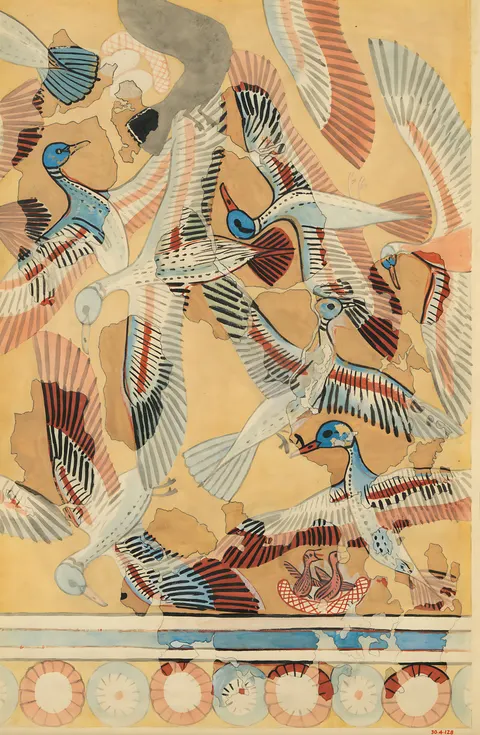
It was painted in the last decade of the 1st century BCE. The square shape sizes from 20×20 up to 40×40 inches. It hangs with the Egyptianizing Scene and Pair of Swans as the Boscotrecase Black Room 2-piece set.
It is printed from The Metropolitan Museum of Art’s photograph of the Roman fresco (Met 250930 / 20.192.1), which The Met marks Public Domain and releases under CC0; the photograph is cropped to the painted surface and enlarged 2× for print, not repainted.
What we did to this scan
Used as the museum photographed and published it: no retouching and no color changes.
Cropped by hand to the painted wall surface, removing the museum's photographic background and the broken edges of the plaster.
Enlarged 2× for print with Real-ESRGAN, an AI upscaler, so the brushwork holds at large sizes.
About this particular sheet. Made from The Metropolitan Museum of Art's Open Access photograph of the fresco, cropped to the painted wall surface (the museum background and broken edges removed) and enlarged 2× for print with an AI upscaler (Real-ESRGAN); the museum's record is linked on this page. Cracks, losses and old repairs are part of the 2,000-year-old wall and are printed as they are.
Every print is credited to its archive here and in your order confirmation. Paper tone and small imperfections of the original are kept on purpose; nothing is redrawn. How we restore.
Questions
What does it show?
A glossy black wall divided by slender golden columns into a little shrine-like frame, with a tiny landscape vignette in the middle, fine gold ornaments and a deep red band along the bottom.
Is it the original fresco?
No. The fresco itself is in The Metropolitan Museum of Art in New York. This is a print of the museum's own photograph of it, which The Met releases under CC0 as part of its Open Access program, enlarged 2× for print. We never sell originals or antiques.
Where does it hang best?
A living room, a dining room, a study or an entry. The deep reds, golds, greens and black suit dark wood, brass, marble and plaster walls. It also suits black and gold rooms.
Where does this image come from?
From the Metropolitan Museum of Art (Met 250930 / 20.192.1), linked on this page. Public domain: Roman wall painting, last decade of the 1st century BCE (ancient). The Metropolitan Museum of Art marks this object Public Domain and releases its photograph under Creative Commons Zero (CC0) as part of its Open Access program (Met 250930 / 20.192.1).
How is it made?
It is printed to order for you, in the finish you choose: a float frame canvas, a classic frame canvas, a stretched canvas, a rolled canvas or an acrylic panel. Both frames come in Black or Antique Gold. The size and finish picker shows which sizes each finish is made in.
Colors vary a little between screens and canvas. The previews are drawn, not photographed, and are a close match to the printed piece.
Every size, one wall
All 4 sizes of this print, side by side
To scale, framed, with a 5 ft 6 in figure for reference — so you can see the steps between sizes at a glance before you pick one above.
40×40 in102×102 cm
30×30 in76×76 cm
24×24 in61×61 cm
20×20 in51×51 cm
5′6″ · 168 cm
Left to right: 40×40 in · 30×30 in · 24×24 in · 20×20 in
Every size to scale on one wall, framed in Black, beside a 5 ft 6 in figure. Room photograph generated for scale; the figure is 5 ft 6 in.
Swipe sideways along the wall to see every size
From people who bought it
Reviews come only from verified buyers: we email a personal review link 21 days after delivery. We read every review before it goes up, never edit them, and publish critical ones too. We only hold back reviews that are abusive, defamatory, off-topic or advertising, and we tell the writer why. Review rules